Quantor's production build is signed with an offline Ed25519 key
that never leaves the founder's machine. The public key is open, and the
signed build identity is published at /_identity.json. Anyone with
curl and openssl can confirm the running site serves
exactly the code we committed to the repository.
# 1. Fetch the public key (committed in repo + served at /.well-known)
curl -s https://quantorsaas.app/.well-known/quantor-pubkey > pub.pem

# 2. Fetch the live, signed build identity
curl -s https://quantorsaas.app/_identity.json > id.json
jq -rj '.manifest'  id.json > manifest   # -rj (no trailing newline) or the signature won't match
jq -r  '.signature' id.json | base64 -d > sig

# 3. Verify with openssl
openssl pkeyutl -verify -pubin -inkey pub.pem -rawin -in manifest -sigfile sig
# → "Signature Verified Successfully"
📈 Performance signing key
Monthly performance snapshots and signed audit rows are signed with a separate Ed25519 key. Its public half is served at /.well-known/quantor-perf-pubkey.
This fingerprint never changes during the project's lifetime; any rotation is announced ≥30 days in advance with cross-over verification. Full verify recipe for snapshots lives on /performance.
🔎 Verify a strategy audit
Turn any trade history into a signed, tamper-evident audit — net-of-cost PnL, drawdown, and
whether the claimed edge survives realistic costs. Every report is Ed25519-signed, so a doctored
number breaks verification. Independent, no account needed.
The Spring Boot api, Java worker, and Express site are all signed with
the same offline key before rollout. An Ed25519 signature over the
canonical manifest {service, commit, image_digest, builtAt}
is written into Cloud Run env vars and exposed via identity endpoints.
If someone swaps the image — the signature won't match. If someone
forges the manifest — it won't verify against the committed public key.
What this closes
An attacker with Cloud Run or build-pipeline access who tries to push a malicious image — the Pulse probe catches the mismatch within an hour.
A contractor with temporary deploy rights cannot later sign their own build in our name — they don't hold the key.
"Someone swapped the bytes" stops being a guess and becomes arithmetic: either the signature is valid or it isn't.
2. Explicit risk gates before any LIVE order
Before a real order reaches the exchange, the request passes through a layered chain of
independent checks in strict order. Each gate has a unit test and throws
a structured ProductPolicyException with a specific
risk_code. PAPER mode has only 2 gates — symbol allowlist +
plan allows paper. LIVE passes the full chain.
Symbol allowlistSYMBOL_NOT_ALLOWED
Symbol must be on the permitted list.
Regime guardDANGEROUS
Market must not be in DANGEROUS regime (realised volatility + drawdown).
Runtime kill switchquantor.trading.live.enabled
Global flag must be on.
User allowlistquantor.trading.live.allowedUserIds
User ID must be in the runtime allowlist.
Non-zero notional
Cannot start LIVE on zero order size.
Active subscription
Subscription must be active and current.
Account not frozen
Account in good standing, bot count under plan limit.
Plan allows LIVE
The current plan permits LIVE — FREE does not. Starter allows LIVE on EMA only; advanced strategies (Breakout V1, TS Momentum V1, Adaptive Pro, Custom) require Pro or Teams.
LIVE_ADVANCED modeadvancedStrategies
Advanced mode requires a plan with the advanced-strategies feature.
Telegram linked
Telegram account must be linked — dual-channel control.
Strategy whitelist
Strategy must be in the permitted set for the execution mode.
Exchange keys verified
Exchange API keys must be verified live, not just entered.
Max-notional ladder
Per-plan cap on order notional:
Starter ≤ $250Pro ≤ $5kTeams ≤ $25k
Daily-loss ladder
Per-plan daily-loss circuit breaker (source of truth: PlanLimitsCatalog.java):
Free ≤ 1%Starter ≤ 2%Pro ≤ 5%Teams ≤ 10%
3. Regime detector — we're willing to sit on the bench
Quantor calculates the current market regime from realised volatility
and drawdown from peak. When the regime is DANGEROUS,
LIVE starts are blocked — regardless of plan, allowlist, or any other
permission. PAPER works in DANGEROUS: a hostile market is a great time
to test strategies on paper rather than on real money. The current
regime is open to everyone:
api/v1/market/regime.
The kind of contract this is
Most bots in this category optimise for volume — more trades, more
fees, more vendor revenue. We optimise for "don't lose the user's
money on a bad day." This reduces our own revenue during volatile
periods, and we consider that a conscious trade-off.
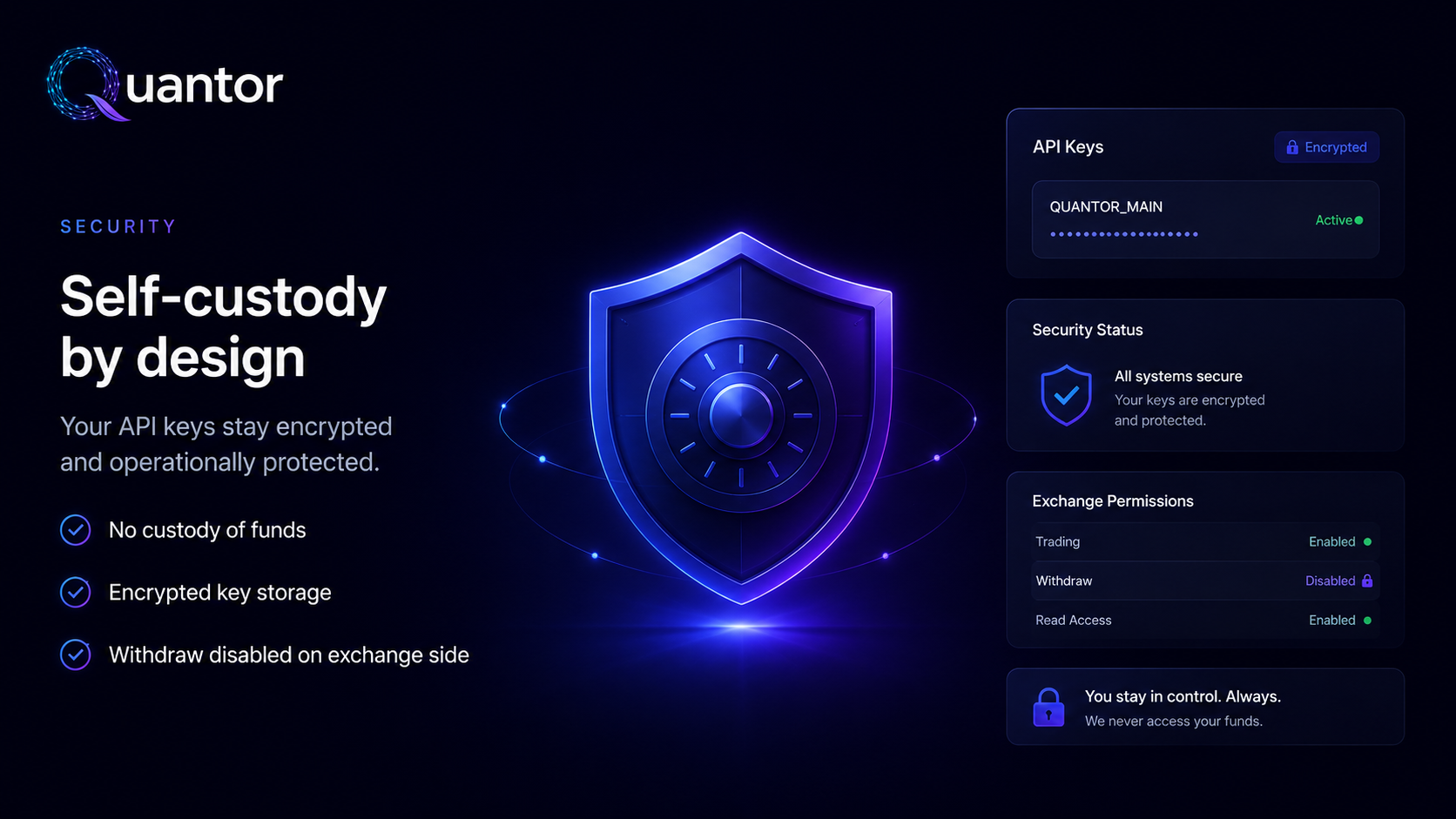
4. Self-custody — by construction, not by promise
Quantor doesn't hold your money. Ever. By design:
You create the exchange API key yourself on the venue you pick in the dashboard. Required permissions: spot trading only, withdrawals disabled — keys with withdrawal permission are rejected during save and verification.
The key is encrypted with an AES-GCM master key that lives in GCP Secret Manager — a separate trust boundary from the database.
The database holds only the encrypted blob + last4 + a verified=true/false flag.
Even if Quantor's database leaks — keys can't be decrypted without the master key. And even if decrypted, funds can't be withdrawn — the exchange key forbids it.
5. Tamper-evident audit chain (Layer B)
Every audit-relevant event written through the API is recorded with a
keyed hash that depends on the previous one:
chain_hash = HMAC‑SHA256(secret, prev_hash || sha256(canonical_payload)).
Any attempt to silently modify or delete a record after the fact
breaks the chain — subsequent hashes stop matching. The HMAC secret
lives in Secret Manager, outside the database, which is the point: an
intruder holding the database cannot recompute a forged chain. The
verifier endpoint reproduces the head hash server-side, and the Pulse
probe obs.audit-chain.head checks integrity every hour.
The one exception, stated rather than buried
If the worker cannot reach the API at the moment a trade closes, it
writes the fill straight to the ledger rather than lose it — a missing
close would corrupt a track record far worse than an unchained one
would. A row written that way carries no per-trade signature and no
chain entry, because both are produced on the API path.
As of 2026-08-31 this has happened twice: two closes on
2026-07-21, out of 203 rows since per-trade signing began. Both sit in
the ledger with correct PnL, and neither is ever served as
“verified” — the public verifier returns not-found for an
unsigned row instead of pretending. A separate hourly sweep — the
ledger-integrity sentinel, not the head-integrity probe above —
counts the unsigned rows and any audit-chain shortfall, so the number is
measured rather than discovered later.
Threat model
The scenario "a future intruder with database access quietly deletes
a bad trade and pretends it never happened" — caught arithmetically.
The scenario "a future founder edits history to suit themselves" —
same. The chain cannot be forged without holding every key and every
hash.
6. Pulse — one-click synthetic probe
13 probes through every layer of the stack in ~10 seconds. Side-effect
free — writes nothing, sends no messages to real users, buys nothing.
If anything turns red, the row shows the exact file:method:line where
the chain broke. It isn't a "notification" — it's a real synthetic
test scenario the operator runs after every deploy.
What it checks
Probe
What it verifies
health
API is alive
db.read
SELECT 1 round-trip via JPA
db.write
insert + delete on pulse_runs
plan.catalog
3 paid plans, limits match the source code
strategy.catalog
7 strategies registered
market.regime
regime detector returns a valid MarketRegime
worker.heartbeat
worker wrote a heartbeat ≤ 60s ago
pipeline.dry-run
EMA strategy processes 100 synthetic candles
audit-chain.head
hash chain reproduces correctly
sentry
DSN is configured
build.signature
Ed25519 signature verifies against the committed public key
Compared to a typical crypto-bot SaaS
Open numbers from public pricing pages as of June 2026. Not an attack
on competitors — just facts.
Typical bot SaaS
Quantor
Build signature
none — unverifiable
Ed25519, public key
Risk policy
usually one — a stop-loss
14 gates + regime guard
Custody
sometimes opaque
API keys, withdraw disabled
Audit chain
plain log (deletable)
hash chain (delete = break it)
Entry price
$25–30/mo
$19/mo
Telegram-native control
notifications only
bot commands + Mini-App
Ready to verify it yourself?
Everything above is not a promise — it's a set of endpoints open right
now. Start by checking the current signature, then take a look at pricing.
The same discipline applied to money:
what our API keys can and cannot do, why the founder's real capital is parked rather
than traded, and what is signed monthly — the Treasury policy.